All articles
Article
Using Timeline Analysis Tools to Help Build Your Fire Investigation Origin and Cause Report
Origin and cause reports are foundational documents in fire investigations. These reports serve not only to document the findings of the fire scene analysis but also become critical exhibits in legal proceedings, insurance disputes, and expert testimony. Given the intense scrutiny these documents often receive, their structure, content, and clarity must be beyond reproach. This blog post, based on expert training materials, outlines how to write a strong, methodologically sound, and legally defensible origin and cause report. We will cover essential sections, legal considerations, scientific methodology, and formatting guidelines, drawing on guidance from NFPA 921, NFPA 1033, and recent forensic science best practices.
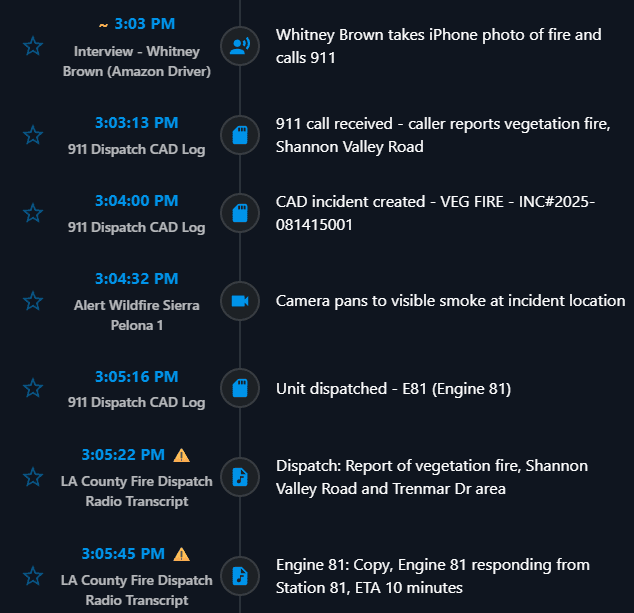
Using Timeline Analysis Tools to Help Build Your Fire Investigation Origin and Cause Report
Origin and cause reports are foundational documents in fire investigations. These reports serve not only to document the findings of the fire scene analysis but also become critical exhibits in legal proceedings, insurance disputes, and expert testimony. Given the intense scrutiny these documents often receive, their structure, content, and clarity must be beyond reproach. This blog post, based on expert training materials, outlines how to write a strong, methodologically sound, and legally defensible origin and cause report. We will cover essential sections, legal considerations, scientific methodology, and formatting guidelines, drawing on guidance from NFPA 921, NFPA 1033, and recent forensic science best practices.
In today’s environment of increasing legal scrutiny, forensic standardization, and peer review, it is essential that fire investigators approach report writing with the same systematic precision used during scene examinations.
The Purpose of the Origin and Cause Report
The fire investigation origin and cause report must clearly document what happened during the investigation and the conclusions drawn by the fire investigator – more specifically the data collected, how the data was analyzed, the hypotheses developed and tested, and the analyses that led to the investigator’s final opinion on origin and cause, and the final hypotheses selected. Those steps should sound familiar as they embody the scientific method.
The report is basically a way to communicate with several different audiences. Clearly the report is written to describe the investigation, record data collected and analyzed, detail the use of industry-accepted methodologies, and convey findings and expert opinions to judges, juries, attorneys, insurance professionals, investigators, and managers. The most important audience for the report, however, may be actually be the fire investigator. The origin and cause report will serve a critical role to remind the fire investigator about the details of their investigation.
In addition, our legal system demands precision and transparency. Courts increasingly require documentation that aligns with accepted forensic methodologies. A poorly written report can be grounds for exclusion of testimony. It is essential to reference documents like NFPA 921, Guide for Fire and Explosion Investigations, and its recommended methodologies within the origin and cause report.
Because a complete origin and cause report must satisfy the above-listed mandates, it should be lengthy and thorough. It will encompass a variety of information in various sections. And one of those should be timeline analysis.
Structure of a Strong Origin and Cause Report
A typical origin and cause report will include several sections. The subjects are usually addressed in either stand alone sections or merged with one or two other related subjects. The format and use of particular sections is not required by any one standard, though the reporting of all relevant data, analyses, and opinions are required. Regardless of how the report is formatted, the goal is the same – to record and report key information, analyses and conclusions. The sections that need to be included in some fashion include:
Investigation Identifiers Including Author and Other Investigators or Agencies
Synopsis of the Incident
Injuries and Fatalities
Scope of the Investigation
Scientific Method and its Use During the Fire Investigation
Data Collection Summary
Witness Statement Synopses
Scene Examination Narrative
Analysis of Fire Patterns and Fire Dynamics
Timeline Analysis
Building Construction and Utilities
Evidence Documented and Collected
Origin Hypotheses Developed, Analyzed, and Tested
Origin Determination
Cause Hypotheses Developed, Analyzed, and Tested
Cause Determination
Conclusions
As needed – References and Appendices (Photos, Diagrams, Scene Sketches, Timeline Data)
Undoubtedly one of the most important sections, depending on the investigation, may be the Timeline Analysis section. Every origin and cause report should document the timeline analysis related to that investigation, especially if the investigators used a forensic software tool for that timeline analysis.
Articulating the Use of Recommended Methodologies Like Timeline Analysis
NFPA 921 lists several methodologies that it recommends investigators use to identify the origin and cause of a fire. It is advisable that investigators, in their report, describe the recommended methodologies they used in the investigation. This shows how the investigator is practicing fire investigation within accepted industry standards.
Recommended methodologies listed by NFPA 921 include Fire Pattern Analysis, Fire Dynamics Analysis, Origin Matrix Analysis, Heat and Flame Vector Analysis, and Timeline Analysis. Every method cited in an origin and cause report should include a statement on how it was applied, what results it generated, and how it informed the conclusion in the investigation.
Anytime we can rely on a methodology or analytical technique recommended in NFPA 921, it will:
Help the analysis (accuracy) – these are effective techniques.
Help build investigator credibility.
Show the court the investigator’s demonstrated use and knowledge of NFPA 921.
Show the court the investigator’s embrace of recommendations within a community-accepted document.
Demonstrate that the investigator reliably used a recommended methodology.
Timeline analysis may be one of the easiest methodologies to use and to claim credit for employing. Every fire has a timeline, and therefore every fire investigation can document at least some part of this timeline. There are times where this timeline may be very slim on detail and maybe consist of only a handful of entries. Other investigative timelines may consist of many entries. But because this data is always available to some degree, each fire investigation should be utilizing a timeline analysis. Remember:
The timeline ultimately generated may have immense value … or very little value.
The timeline ultimately generated May have few or many data points. But this is not a measure of how significant a role this analysis played in the investigation.
Undertaking the timeline analysis methodology in and of itself has value to show the investigator’s understanding of NFPA 921.
The timeline ultimately generated can be used to assess the investigation for gaps or deficiencies.
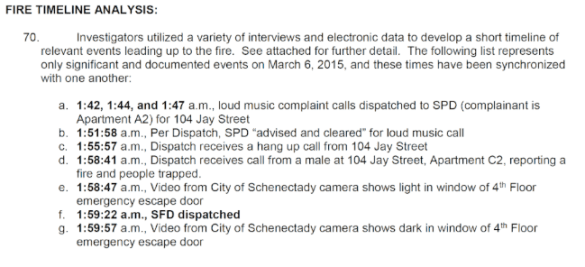
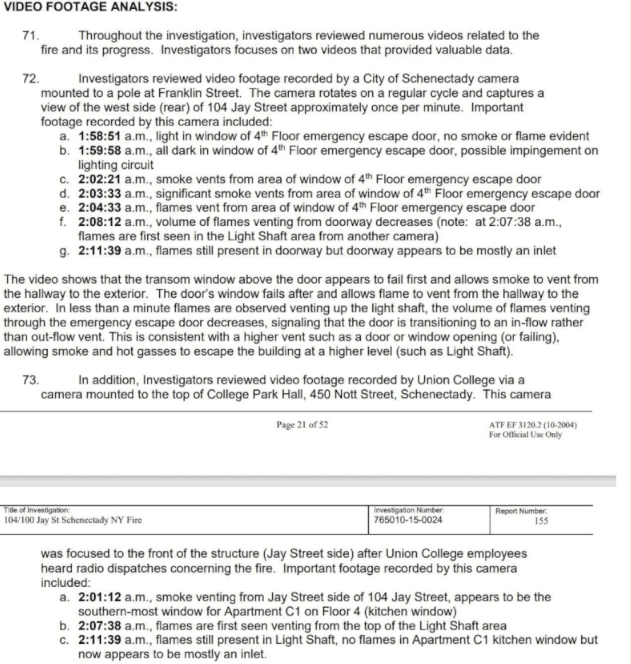
The timeline analysis articulated should be direct and simple yet contain key information. The timeline data recorded in the origin and cause report should be in the form of master timeline, listing several sources and data points, and include specific information on:
Source of the data (e.g. “Kip’s Corner Store”)
Type of data (e.g. “Video”)
Description of event (e.g. “Two males seen walking towards house”)
Time of event (e.g. “10:42:33”)
Identification of time being an estimated time or a hard time (e.g. “hard time”)
Identification of the offset and/or whether the time was synchronized (e.g. “time stamp shows 11:42:33”)
An example of a master timeline may look something like the following starting with a source index and then the master timeline:
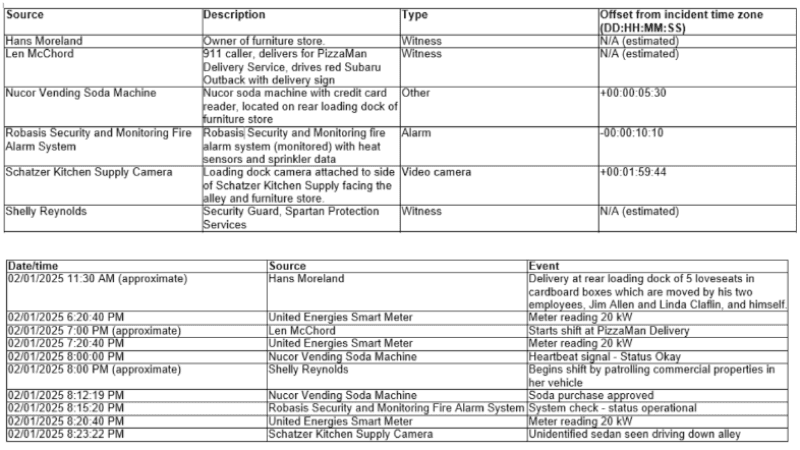
It is not necessary to report every event in the master timeline, but certainly the critical events and the events immediately before and after those key events. The report can contain a synopsis of the master timeline while the complete timeline can be a standalone document or reported in a separate document. If an abbreviated timeline is contained within the origin and cause report, this should be noted, and the location of the complete master timeline should be identified.
Within the timeline analysis section, investigators may wish to include certain short caveats:
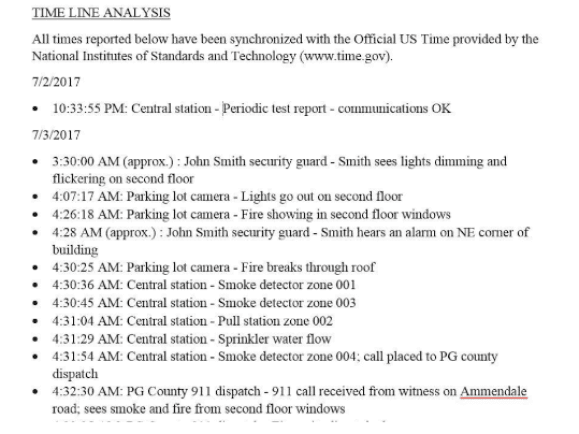
Addressing synchronization
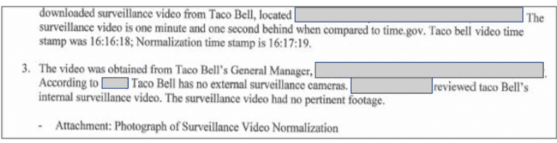
This could include a statement such as, “All times reported below have been synchronized with Official U.S. Time provided by the National Institutes of Standards and Technology (www.time.gov).”
The caveat here could even include a photograph on investigators collecting synchronization times while with the witness:
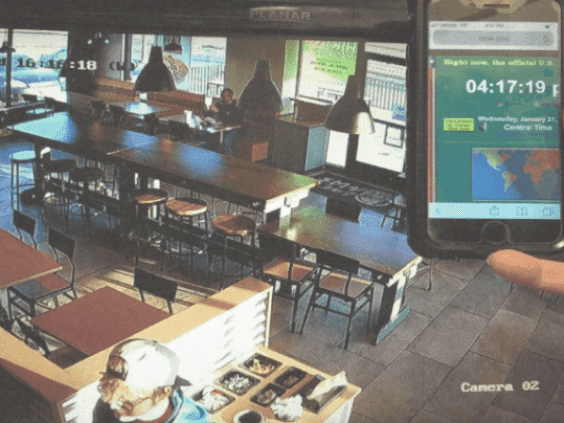
And if dealing with one particular source, if necessary, the investigator can include language identifying the offset:
Addressing approximate times
This could include a statement such as, “Estimated times in the timeline are prefaced by the abbreviation ‘Approx.’ to denote that the time is an approximation.”
Addressing abbreviated master timelines
This could include a statement such as, “The timeline entries below represent a portion of the overall timeline constructed for this event. The master timeline, containing all timeline entries identified by investigators, is attached to this report in Appendix A.”
If the investigator has used an AI tool for building the timeline for their investigation, the investigator should consult with their team and determine whether that should be recognized within their report as well. There are impactful reasons to do so and not to do so, and therefore caution is warranted. If the team decides that noting it in the report is warranted, the use of AI should be specific to what was it was asked to do, what product it generated, and then how the investigator analyzed the AI response. There is no prescribed format for such a statement an it is up to the judgment of the report’s author.
For example, if an investigator used TimeScene’s forensic software tool for timeline construction, and used its enhanced AI analysis features, the investigator may want to consider documenting that in their origin and cause report. The statement could be something as simple as, “Investigators utilized TimeScene, an AI-assisted software program, to identify potential timeline data. Investigators examined the results generated by the AI-assisted software program, which reviewed scanned documents submitted by the investigators, and determined whether it had identified relevant timeline data.” Or it could be more complex:
Artificial intelligence (AI) tools were utilized to assist in the identification and analysis of data relevant to the timeline of this fire incident. The findings generated by these AI systems are based on available data and algorithmic processing, which may not fully capture all nuances specific to this case. All AI-generated outputs were reviewed and interpreted by the undersigned investigator, and final conclusions regarding the origin and cause of the fire were made solely by the investigator. While AI can enhance investigative efficiency and accuracy, it may also introduce potential biases or errors depending on the nature of its training data. Accordingly, the use of AI in this investigation is intended as a supplementary tool, and does not replace professional judgment, human oversight, or established investigative standards.
It is recommended that investigators generate their timeline before generating their origin and cause report. Logic dictates that generating a timeline before drawing conclusions and writing and origin and cause report is necessary if the investigator is truly going to demonstrate the proper use of the scientific method (i.e. analyzing data and testing hypotheses before drawing conclusions).
Investigators should have a method to draft, edit and finalize their timelines. This can be as simple as creating a document in Word or Excel. A better option is to utilize a forensic software tool for timeline construction, like TimeScene’s product, which allows the investigator to not only enter and sort the data, but to export it in a variety of formats for use in origin and cause reports and other documents.
The timeline analysis section should also not only list data, but provide an explanation or interpretation of the data. If possible, it should be articulated what the timeline analysis allows the investigator to conclude (or not to conclude).
Evaluating Witness Statements and Contextual Data
Witness statements are important, but must be evaluated for reliability. Your report should:
– Discuss whether multiple witnesses confirmed key facts
– Highlight inconsistencies and evaluate their significance
– Link witness accounts to physical evidence or eliminate them if uncorroborated
According to NFPA 921, all witness-provided data must be evaluated for accuracy, context, and relevance. If used in hypothesis testing, make this clear in the report.
Evaluate the quality and relevance of witness statements. Be transparent about inconsistencies and explain their significance. Affirmatively address bias by referencing NFPA 921’s definitions and explaining how you avoided cognitive or confirmation bias.
The timeline analysis section may repeat data provided in the witness interview synopses, but this is acceptable. Investigators need to have a clear presentation of a master timeline within their report, even if it reflect data previously described in another section.
Administrative and Technical Reviews of the Origin and Cause Report
NFPA 921 recommends that origin and cause reports undergo administrative and technical reviews. The administrative review is used to examine grammar and structure while the technical review is used to ensure that the report is technically sufficient and complete, the investigator followed proper methodology, and that the conclusions are accurate.
The technical reviewers should be reviewing the timeline analysis in detail to identify any in accuracies or gaps in interpretation. Technical reviewers should take time to examine the source data and compare that to any mater timelines reported. Like every aspect of the technical review, communications between the investigator and the technical reviewer may be discoverable in legal proceedings.
Conclusion
The quality of an origin and cause report can make or break an investigation in the courtroom. Fire investigators must document sound methodology, use clear writing, and demonstrate thorough documentation to ensure their work meets legal and professional standards.
Specifically, writing a high-quality origin and cause report demands that an investigator:
– Demonstrate clear methodology and structured thinking within the report
– Show deep familiarity with NFPA 921 and 1033 and the recommended methodologies referenced in them
– Produce a well-formatted, accurate, and objective report
– Include robust hypothesis testing
– Had the report thoroughly reviewed
TimeScene empowers fire investigators with intuitive timeline-building tools, robust evidence management, and seamless collaboration features—streamlining every phase of building and documenting an investigative timeline. By leveraging TimeScene, you can capture every critical detail, visualize incident progression, and generate comprehensive reports with unprecedented efficiency and accuracy. You can choose to format these reports before they are generated in such a way that best fits the incorporation of your timeline into your final documentation. Don’t let valuable insights slip through the cracks—start using TimeScene today and transform how you document, analyze, and resolve fire investigations. Your next investigative breakthrough could be just a timeline away.
Have a case where timing matters?
Tell us what happened and what’s coming up. We’ll show you how TimeScene could help.